When a child comes across a question they cannot answer immediately, it can be all too tempting to help them reach the solution as quickly as possible; however, earning to persevere and consider different approaches is a skill that will serve them well beyond the classroom and throughout their lives.
What is problem-solving?
In maths, a familiar question might simply require pupils to recall a method they have already learnt, whereas a genuine problem presents a different challenge: first they must work out what is being asked, then decide how to tackle it.
Why is problem-solving important for children?
It builds confidence, resilience and independence: children learn to keep going when something is hard, and those who can explain how they reached an answer understand it more deeply. At The Downs Malvern, problem-solving is taught explicitly, rather than left to chance. Liz George, Head of Maths, explains that pupils are encouraged “to persevere when things get hard, to be strategic and systematic, to try new strategies or seek advice”. Children work in pairs and practise explaining their reasoning to the class, and they also learn to check answers using techniques such as rounding and inverse operations. When someone gets stuck, a small hint can often be far more valuable than being shown the solution.
Right answers still matter
Of course, none of this diminishes the importance of getting things right. Secure times tables, number facts and mathematical methods provide the foundations that make more ambitious thinking possible. It is also worth noting that for many pupils, confidence is half the battle, and so from Pre-Prep onwards, regular practice and revisiting earlier learning help them build the knowledge they need to approach unfamiliar questions with greater confidence.
The Year 6 Maths Challenge
This autumn, we will welcome Year 6 pupils from ten local schools, including our own, for our annual Year 6 Maths Challenge. This popular event sees each school bring four children to compete, but rather than the traditional school-against-school format, the 40 participants are mixed into teams.
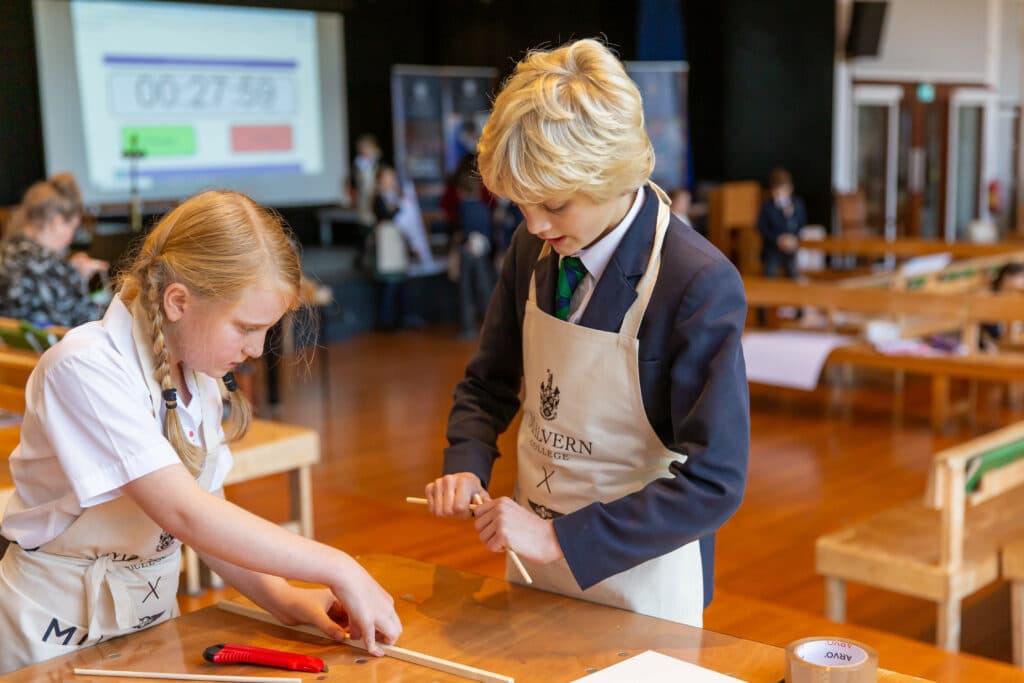
Across five rounds, they tackle everything from Japanese logic puzzles to cross-number and relay challenges. There’s also a 20-minute STEM engineering task in which teams build a roller coaster, with marks awarded for how long it stays in motion and the engineering skills demonstrated. This takes mathematical thinking beyond the page, challenging pupils to apply their knowledge to a practical problem that also calls for creativity.
Working alongside unfamiliar teammates adds another dimension to the challenge, as pupils must share their ideas, consider different approaches and decide together what to try next.
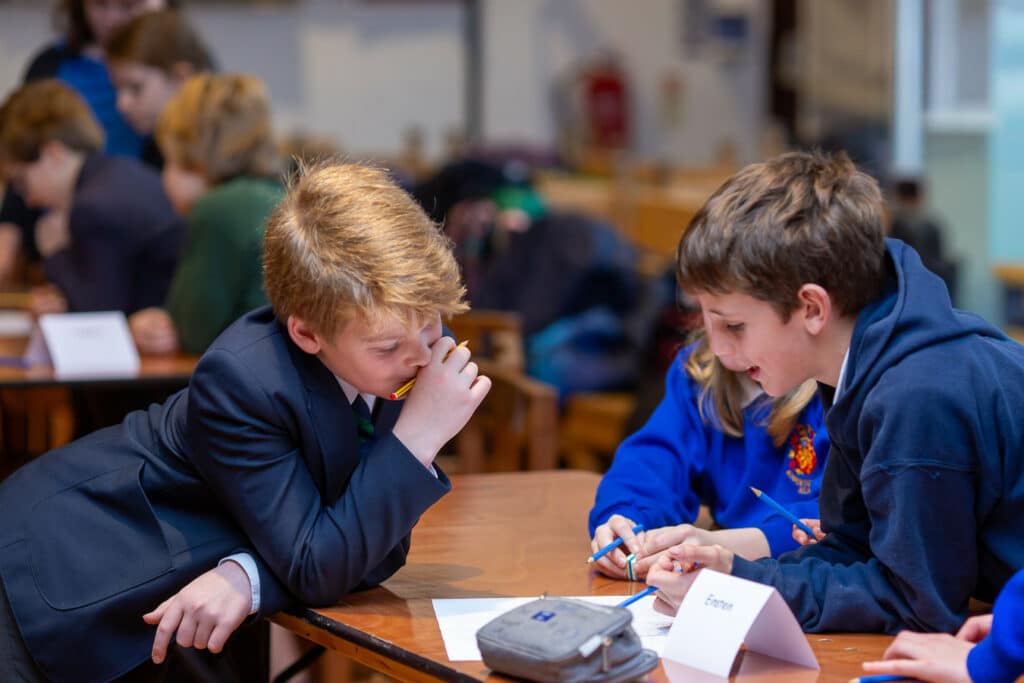
The annual Year 6 Maths Challenge
When there isn’t one right answer
As with the roller coaster STEM activity, our approach to problem-solving extends well beyond mathematics. In 2025, our Year 5 pupils joined children from Malvern Wyche Primary School for the at The Downs Malvern, an exciting morning of automotive-inspired creativity and problem-solving.
With a real Morgan car brought into school especially for the occasion, pupils had the opportunity to examine it up close and explore its distinctive features before discovering how automotive designers develop their ideas from scratch. They then set about imagining their own Morgan of the future. An activity called Pass the Picture encouraged them to take inspiration from different images and develop their designs collaboratively, before working in teams to create three-dimensional concept models.
Unlike a calculation with one correct result, a design brief leaves room for different solutions. The challenge is to make choices, weigh up possibilities and find a way of turning an idea into something tangible.
The Morgan Experience
Why the process matters more than the result
Our annual Great Egg Launch provides perhaps the clearest reminder that the best learning isn’t always reflected in the final result. Pupils are challenged to build devices that propel an egg as far as possible while protecting it on landing.
Steve Thomas, Deputy Head Academic and Head of Science, recalls one group’s entry that travelled only two or three metres. It wasn’t the winning distance, but the care and ingenuity behind the design made it stand out to him.
“There is a real culture here that encourages experimentation and allows room for mistakes,” Steve explains. “It’s so important because reflecting on mistakes and trying again are essential components of success.”

The annual Great Egg Launch
Building skills that last
These experiences also help prepare children for the greater independence expected as they progress through their education. Unlike most schools, where children move into secondary education in Year 7, pupils at The Downs Malvern remain with us until the end of Year 8, giving them two additional years to develop their confidence and independence before moving on to senior school.
During these final two years, pupils follow The Downs Malvern Baccalaureate, a bespoke programme combining academic study with enrichment opportunities and personal development. At its heart are seven Skills to Thrive, including resilience, which encourage pupils to embrace challenges, think independently and take greater ownership of their learning.
Tips: helping your child solve problems at home
- Pause before helping. Give them time to think.
- Ask, don’t tell. Try “What have you tried so far?”
- Look again. Encourage them to reread the question carefully and underline key information. An overlooked detail can make all the difference.
- Invite an explanation. Ask how they reached their answer.
- Praise the thinking. Recognise effort, thoughtful questions and a willingness to try again.
- Make mistakes ordinary. Talk about what they’d change next time, and let children hear you working through everyday problems yourself.
Problem-solving: questions parents ask
Why is problem-solving so important for children?
It helps children develop the confidence to tackle unfamiliar challenges, apply their knowledge and make decisions independently.
Is problem-solving only important in maths?
Not at all. From designing and engineering to everyday decisions, children use problem-solving skills across different subjects and situations.
How do strong maths foundations support problem-solving?
Secure knowledge of number facts, times tables and mathematical methods gives children the tools they need to tackle more complex and unfamiliar problems.
How can I help my child with problem-solving at home?
Ask questions instead of giving answers, give them time to think, and praise how they worked something out. Letting them make small mistakes and try again is part of the process.
At The Downs Malvern, we want pupils to leave us knowing not only what they’ve learnt, but how to keep learning. To discover more about our approach, contact our Admissions team to arrange a visit.